
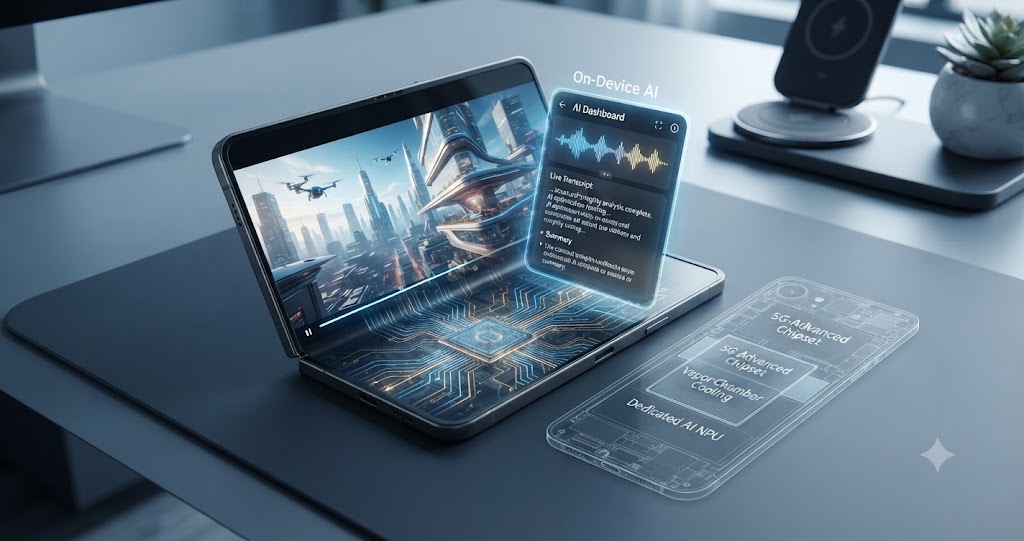
In 2026, the smartphone has evolved from a passive communication tool into an “AI-native” central hub. Current flagship devices now leverage on-device neural engines to handle complex offline reasoning, while advancements in foldable hinge durability and satellite connectivity are redefining what it means to carry a professional-grade computer in your pocket.
Key Takeaways for 2026
- On-Device AI: Processing power is shifting from the cloud to your local chipset, enhancing privacy and speed.
- Foldable Evolution: Designs are now 30-40% thinner than previous generations with improved crease resistance.
- Camera Tech: 200MP sensors paired with AI-driven image processing are the new baseline for top-tier flagships.
- Connectivity: 5G-A (Advanced) and direct-to-satellite messaging are becoming standard for premium models.
- Longevity: “Right to Repair” initiatives are driving manufacturers to offer longer software support and modular component designs.
The AI-Native Paradigm Shift
Forget simple “smart” features. In 2026, the defining characteristic of a flagship is its AI-native Operating System. Unlike previous years where AI was a cloud-based request/response feature, current chips (like the latest Snapdragon Elite and Apple A-series) feature dedicated neural cores designed to run large language models locally.
When you are editing a video or summarizing a transcript on your device, the heavy lifting happens on the silicon, not on a remote server. This means you get near-instant results even without an internet connection, significantly reducing latency and boosting data security.
Comparison: Defining Smartphone Tiers in 2026
| Feature Set | Mid-Range (e.g., Pixel 10a) | Ultra-Premium Flagship (e.g., S26 Ultra) |
| Primary Focus | Software experience & Value | Pure performance & Photography |
| AI Capabilities | Cloud-assisted / Basic local | Advanced offline agents |
| Charging | 30W – 65W | 100W+ Hyper-charging |
| Build Materials | Reinforced Polycarbonate | Titanium & Aerospace Alloys |
| Satellite Access | Limited / SOS only | Full satellite messaging/calls |
The Hardware Revolution: Beyond the Slab
While the “classic” bar phone remains, the foldable market has hit its stride. The primary complaint of the 2024–2025 era—bulkiness—has been solved.
1. The Hinge and Screen Breakthrough
New materials allow for foldable screens that are virtually indistinguishable from glass in terms of touch feel. The “crease” is now largely a relic of the past, thanks to dual-track hinge mechanisms that pull the display taut when opened.
2. Satellite Connectivity
We are no longer tethered to cell towers. In 2026, top-tier phones support 5G-A and direct-to-satellite links. This is a game-changer for hikers, travelers, and anyone living in remote areas where “dead zones” were once a standard part of life.
How to Future-Proof Your Next Purchase
A common bottleneck in mobile performance is not the processor—it’s the battery and thermal management. As AI tasks become more frequent, they generate heat.
- Thermal Dissipation: Look for devices with advanced vapor chamber cooling systems. If a phone gets hot during simple tasks, it will throttle its performance once more demanding AI background processes kick in.
- Storage Architecture: With AI models living on your device, aim for 512GB of internal storage as the new “base” if you plan to keep the phone for more than 3 years.
- Battery Health: Modern AI-first phones consume power differently. Prioritize devices that offer “Battery Protection” modes, which cap charging at 80% to preserve chemical longevity over years of use.
Understanding 5G-Advanced and Connectivity
We are moving beyond standard 5G into the realm of 5G-Advanced. In practice, this means:
- Lower Latency: Real-time gaming and high-fidelity AR/VR streaming.
- Improved Uplink: Essential for creators uploading 8K video content directly from the field.
- Network Slicing: Your phone can prioritize bandwidth for critical apps while background tasks take a backseat.
Frequently Asked Questions
Q: Are AI features really a necessity or just marketing hype?
A: In 2026, it is both. While early AI features were gimmicky, the current iteration of “AI Agents”—software that can perform tasks on your behalf like booking travel or managing complex work logs—will fundamentally change how we interact with our devices daily.
Q: Should I wait for the next generation of foldable phones?
A: If you value portability and durability, the 2026 generation is the first to reach true parity with slab phones. You are no longer sacrificing build quality for form factor.
Q: Is 200MP camera resolution actually better?
A: High megapixel counts alone don’t equal better photos. The real difference in 2026 is the synergy between the large sensor and the AI-driven Image Signal Processor (ISP), which reconstructs images in low light by analyzing every pixel for noise reduction and color accuracy.
Q: How do I know if my phone is “AI-ready”?
A: Look for the chipset generation. Chips released from late 2025 onwards are specifically optimized for local Large Language Model (LLM) execution. If the manufacturer markets “On-device AI,” you are likely safe.