
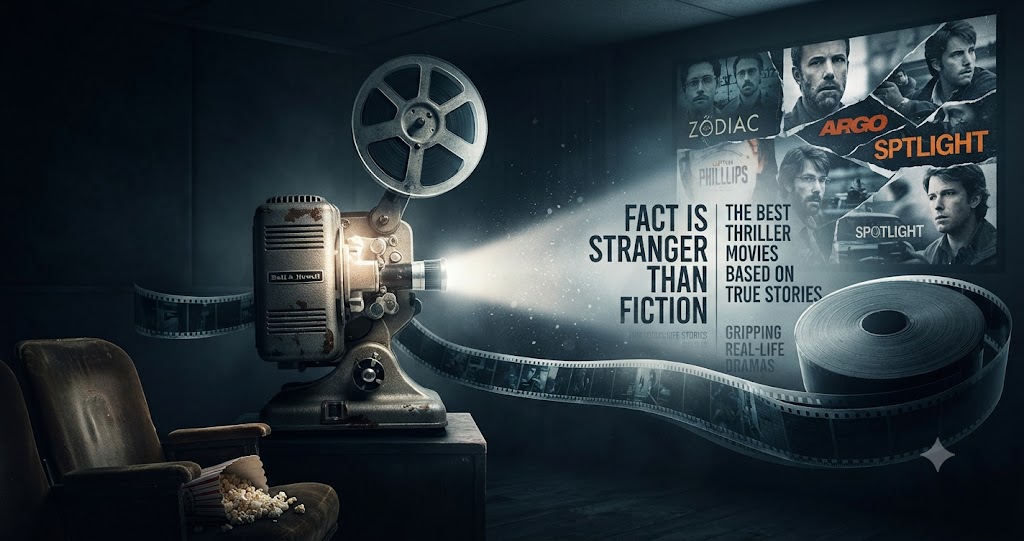
The most gripping thriller movies based on true stories aren’t just entertainment—they are visceral reconstructions of the moments where reality fractured. From the chilling precision of cold-case investigations to the high-stakes survival of ordinary people in impossible situations, these films leverage “fact-based tension” to deliver a psychological impact that purely fictional narratives struggle to match.
Key Takeaways
- Why they work: True-story thrillers anchor their stakes in reality, making the danger feel immediate and plausible rather than manufactured.
- The “Gold Standard”: Look for films that balance factual accuracy with a strong, active protagonist—the hero must do something to change their fate.
- The Anatomy of Tension: Great thrillers in this genre use the “known outcome” (we know what happened) to fuel suspense about the how and why.
Defining the “Fact-Based Thriller”
Why do we find these films so haunting? It comes down to plausibility. Unlike horror, which often relies on the supernatural, these thrillers use the “banality of evil” or the sheer randomness of fate.
Essential Elements of a High-Stakes True Story Thriller
| Element | Why it Increases Suspense |
|---|---|
| Plausible Antagonists | Real-world threats (corrupt systems, serial killers) are more relatable than monsters. |
| The “Ticking Clock” | Real events often involve narrow windows of survival or capture. |
| Distorted Perception | Using unreliable narrators (even when based on real people) to mirror the confusion of the actual event. |
Masterclass in Suspense: Top Recommended Films
Zodiac (2007)
Directed by David Fincher, Zodiac is widely considered the gold standard for the “procedural thriller.” It focuses not on the gore, but on the obsession.
- The Hook: It tracks the multi-decade search for the Zodiac Killer.
- Why it dominates: It avoids Hollywood tropes. The heroes (Robert Graysmith, Paul Avery) don’t “win.” They are hollowed out by the search. In practice, this means the tension is maintained by the creeping realization that some mysteries never close.
Captain Phillips (2013)
A masterclass in the “survival thriller.” It depicts the hijacking of the Maersk Alabama by Somali pirates.
- The Hook: Captain Richard Phillips (Tom Hanks) must protect his crew while being held hostage.
- Strategy: The film succeeds because it treats the pirates as desperate, complex individuals rather than simple “villains,” creating a terrifyingly realistic negotiation dynamic.
The Psychology of Realism: Why We Can’t Look Away
When you watch a thriller based on a true story, your brain enters a different processing mode. You aren’t just asking “Will they survive?” You are asking “What would I have done in that chair?”
The “Active Protagonist” Framework
For a true story to be a great thriller, the protagonist must be active. Passive characters who are merely victims of circumstance rarely make for compelling cinema.
- The Inciting Incident: The character faces an irreversible threat.
- The Escalation: Stakes must rise from “inconvenience” to “life-altering.”
- The Confrontation: The protagonist must make a choice that directly impacts the outcome—even if that outcome is tragic.
Frequently Asked Questions (FAQ)
Q: Are these movies 100% accurate?
A: Rarely. Filmmakers often combine characters, condense timelines, and dramatize dialogue to fit a 2-hour structure. Treat them as “dramatic adaptations” rather than documentaries.
Q: Why are so many true-story thrillers about serial killers?
A: Serial killer cases provide a natural narrative structure: the discovery of a crime, the investigation, and the climactic confrontation. This mirrors the classic “hero’s journey” structure.
Q: What is the difference between a crime drama and a crime thriller?
A: A crime drama focuses on the character development and the systemic issues (e.g., The Trial of the Chicago 7). A crime thriller focuses on the tension, the pace, and the threat of imminent danger (e.g., Zodiac).