
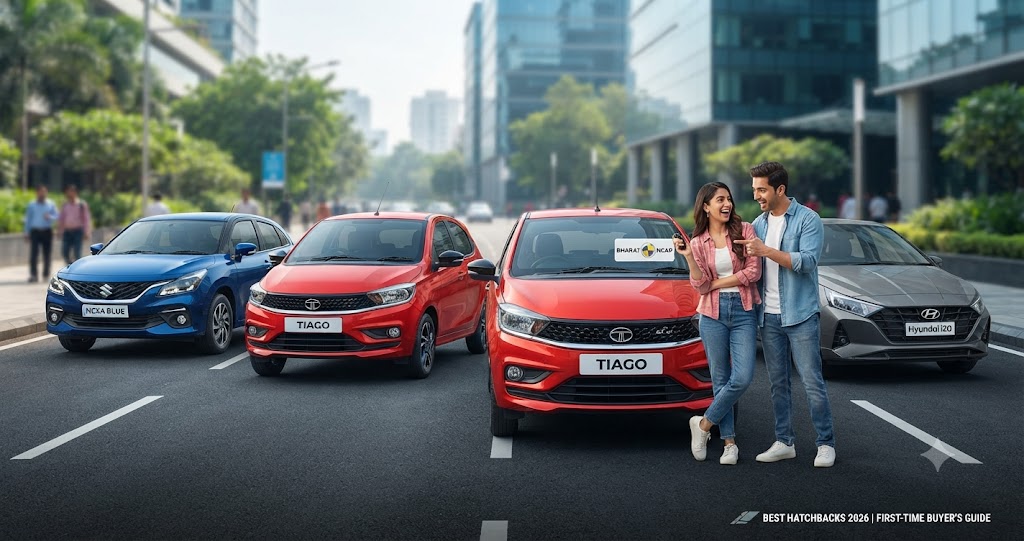
Buying your first car is a milestone, but the Indian market in 2026 is noisier than ever. Between the surge in affordable EVs, the shift toward standardized six-airbag safety, and the “real” on-road cost vs. ex-showroom sticker price, it’s easy to make a costly mistake. This guide cuts through the marketing fluff to help you choose a hatchback that fits your life, not just your parking spot.
Decoding the “Real” Cost of Ownership
The biggest bottleneck for first-time buyers is the “sticker price delusion.” Manufacturers advertise ex-showroom prices, but that number doesn’t include road tax, registration, or the mandatory first-year insurance.
The Budget Framework
To avoid financial stress, use this formula for your 2026 purchase:
$$Total Cost = Ex-Showroom + (Ex-Showroom \times 0.15)$$
- Fixed Costs: Insurance (typically ₹25k–₹45k for entry hatchbacks) and RTO charges (8–12% depending on your state).
- Variable Costs: Factor in roughly ₹8,000–₹12,000 per month for fuel, routine service, and basic upkeep if you clock 1,000 km monthly.
Top Hatchbacks for 2026: A Comparative Snapshot
| Model | Primary Strength | Best For | Approx. Starting Price |
| Maruti Baleno | Reliability & Space | Daily City Commutes | ₹5.99 Lakh |
| Tata Tiago | Safety (Build Quality) | Safety-Conscious | ₹4.70 Lakh |
| Hyundai i20 | Premium Cabin Feel | Comfort & Features | ₹6.00 Lakh |
| Tata Tiago EV | Low Running Cost | Early EV Adopters | ₹6.99 Lakh |
| Maruti Swift | Driving Dynamics | Young First-Time Drivers | ₹5.79 Lakh |
The “Anti-AI” Guide to Picking Your Perfect Match
A. The Safety Hierarchy
In 2026, don’t just look for “ABS.” Demand six airbags as standard, which is now common across most top-selling hatchbacks. Check the BHARAT NCAP rating. If a car doesn’t have a published crash test rating from a recognized authority, be skeptical of its structural integrity.
B. Fuel Type Strategy
- Petrol: Ideal for < 800 km/month. High convenience, no complex refueling, and minimal maintenance.
- CNG: The “Wallet Saver.” If you drive 1,200+ km/month, the investment pays off in roughly 18 months.
- EV: Only if you have a private charging point. Public charging infrastructure is improving, but it remains a “lifestyle change” that adds planning time to your daily routine.
Avoiding the “Buyer’s Remorse” Bottleneck
A common bottleneck is choosing a car that looks good in a video but fails your “real life” test. Before you book:
- The “Four-Adult” Test: Can you fit four adults comfortably for 30 minutes? If your rear seat feels cramped, your passengers will hate the car.
- Ground Clearance Check: If your locality faces monsoon waterlogging, choose cars like the Exter or higher-ground-clearance hatchbacks.
- Service Proximity: Never buy a car brand that doesn’t have a service center within 10 km of your home.
Frequently Asked Questions
Is it better to buy a base-model premium hatchback or a top-model entry hatchback?
Usually, a top-model entry hatchback (like a fully-loaded Tiago) provides a better quality-of-life experience (touchscreen, reverse camera, alloys) than a stripped-down base variant of a larger car.
Are electric hatchbacks worth it in 2026?
If your daily commute is high, the savings on fuel are massive. However, ensure you calculate the battery replacement lifespan—most manufacturers now offer decent 8-year warranties on EV battery packs.
Does ADAS matter in a hatchback?
Advanced Driver Assistance Systems (ADAS) in budget cars can be intrusive. Unless you do extensive highway driving, it is not a mandatory requirement for a first-time city buyer.
Since you are clearly diving into the research phase of buying a car, have you already decided if you prioritize fuel economy over raw performance for your daily driving?